A functional history of surveillance

From reality to control.

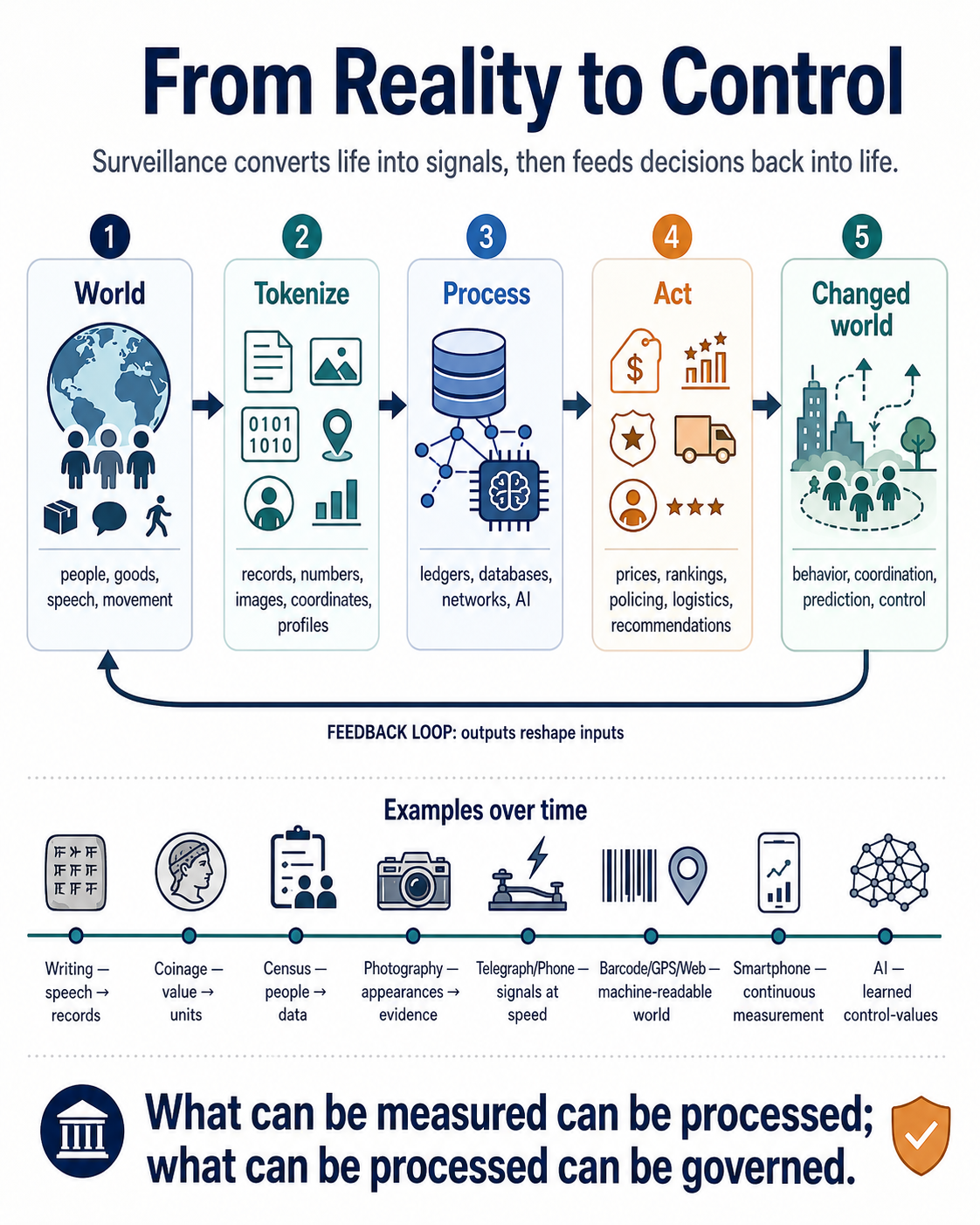
Surveillance is not only watching. It is the conversion of reality into usable signals, the processing of those signals by institutions and machines, and the return of decisions that reshape the world being measured.

TPIT viewIntelligence receives tokens, transforms them, and produces output tokens that alter future state, behavior, or coordination.
LVT viewMeasurement tokens become control-values such as prices, rankings, permissions, recommendations, and alerts.
Infographic showing reality becoming signals, then processing, action, and feedback into a changed world.
Core concept

Surveillance turns the world into signals that systems can act on.

The simplest way to understand the timeline is as a sequence of tokenization systems. Writing turns speech and obligation into records. Coinage turns value into units. Census work turns people into population data. Photography turns appearances into evidence. Barcodes, GPS, the web, smartphones, and AI make goods, places, documents, behavior, and language machine-readable.

The result is a feedback loop. First, reality is measured. Then measurements are stored, transmitted, linked, ranked, and modeled. Finally, the outputs return as control-values: prices, routes, permissions, scores, recommendations, police attention, logistics decisions, and forms of reputation.

Tokenize

Convert persons, objects, places, speech, value, and behavior into records or signals.

Process

Move those signals through ledgers, archives, networks, databases, algorithms, and AI systems.

Act

Feed outputs back into life as coordination, prediction, incentives, restrictions, and control.

Expanded timeline

Each technology changes what can be measured, processed, and governed.

This timeline expands the supplied document into a website structure. Each entry is written at first-year university level and mapped to the same TPIT/LVT pattern: measurement tokens, processing system, and control-values.

Writing is the first major turn from social memory to external memory. Once a debt, name, law, shipment, or promise can be marked outside the body, coordination no longer depends only on trust, presence, or local reputation. In TPIT terms, writing converts lived events into tokens that can travel across time. In LVT terms, those records become control-values because they can decide who owes what, who owns what, and what an institution can demand later.

Measurement tokensspeech, goods, debt, law, labor, identity
Processing systemclay tablets, marks, archives, scribal administration
Control-valuescontracts, receipts, legal memory, taxation, organized labor
Open background link โ†—

Coinage turns value into a portable token that strangers can recognize. The important point is not only economic exchange; it is standardization. A coin lets distant people coordinate around a shared unit without knowing one another personally. It also gives states a tool for tribute, military payment, fines, and taxation. Value becomes measurable, comparable, and governable.

Measurement tokensmetal, seal, denomination, value, authority
Processing systemmints, markets, taxation, tribute, state backing
Control-valuesprices, military pay, market comparison, tax collection
Open background link โ†—

Printing changes the scale of observation. A name, law, map, price, accusation, or doctrine can now be copied many times and acted on by distant readers. Surveillance is no longer only what one observer sees in one place. It becomes replicable: the same record can appear in many locations, creating synchronized attention and shared categories of judgment.

Measurement tokensnames, rules, maps, accusations, prices, doctrines
Processing systempresses, booksellers, pamphlets, archives, reading publics
Control-valuesstandardized law, mass notices, reputation effects, doctrine
Open background link โ†—

Double-entry bookkeeping makes an organization visible to itself. Goods, debts, credit, capital, and obligations become entries in a self-checking system. The firm becomes a measurable object rather than just a collection of people and transactions. This is surveillance directed inward: the organization watches its own flows so it can coordinate, correct, and control them.

Measurement tokensdebits, credits, assets, liabilities, capital, obligation
Processing systemledgers, balances, audit trails, merchant houses
Control-valuesprofit, accountability, solvency, managerial control
Open background link โ†—

The newspaper turns current events into a repeated public measurement cycle. Politics, war, prices, scandal, and reputation are not merely known locally; they are packaged and synchronized for a reading public. The result is a new kind of social timing. People can coordinate around what is reported this week, not only around what they personally witnessed.

Measurement tokensevents, prices, war reports, scandal, reputation, opinion
Processing systemperiodic publication, postal routes, reading publics
Control-valuespublic attention, political synchronization, market awareness
Open background link โ†—

A postal system creates an addressable communications grid. People, offices, newspapers, and businesses can be reached through routes. This matters because surveillance and coordination require not just records, but paths. Once a person or office becomes addressable, messages, notices, demands, bills, and political information can move through a structured network.

Measurement tokensaddresses, names, offices, letters, newspapers, routes
Processing systempost roads, post offices, sorting, routable communication
Control-valuespolitical coordination, commerce, administration, identity by address
Open background link โ†—

The census converts population into a recurring measurement object. A person is not only a citizen, resident, worker, or family member; they also become a counted unit inside an administrative table. The state can then use that table for representation, taxation logic, planning, and policy. This is one of the clearest examples of measurement becoming governance.

Measurement tokenshouseholds, persons, categories, counts, districts
Processing systemenumeration, federal reporting, apportionment machinery
Control-valuesrepresentation, taxation logic, state capacity, population policy
Open background link โ†—

Photography gives surveillance a mechanical visual record. A face, street, battlefield, workplace, or crime scene can be captured as an image rather than only described by a witness. That changes evidence. It also changes power, because institutions can sort, compare, store, and circulate appearances as if the image were a direct piece of reality.

Measurement tokensfaces, bodies, places, scenes, documents, visual traces
Processing systemcameras, archives, police records, newspapers, identification systems
Control-valuesproof, classification, memory, identity, visual authority
Open background link โ†—

The telegraph collapses distance for written signals. Information that once moved by horse, ship, or train can now move through a wire. Markets, newspapers, railroads, armies, and governments can coordinate around near-real-time messages. In the surveillance arc, the key change is speed: tokens no longer only persist; they move fast enough to steer action while events are still unfolding.

Measurement tokensmessages, prices, commands, news, alerts
Processing systemwires, operators, codes, exchanges, newspapers, markets
Control-valuesnear-real-time markets, railroad control, military coordination, policing
Open background link โ†—

The telephone makes distant voice interactive in real time. Coordination shifts from sending documents to sharing live presence across a network. This matters because it turns relationships themselves into networked events: calls can be routed, billed, logged, traced, and synchronized. The voice remains human, but the conditions of contact become infrastructural.

Measurement tokensvoice, number, call, line, exchange, relationship
Processing systemswitchboards, telephone networks, directories, live circuits
Control-valuesreal-time coordination, business control, emergency response, social presence
Open background link โ†—

Hollerith tabulation turns census information into machine-readable cards. That makes population measurement faster and more scalable than manual counting. The deeper shift is from written administration to computational administration. People are represented as holes in cards, and those cards can be sorted, counted, and recombined by machines.

Measurement tokenspunched cards, census attributes, categories, counts
Processing systemtabulators, sorters, punched-card computation
Control-valueslarge-scale administration, faster statistics, data processing industries
Open background link โ†—

Radio creates one-to-many real-time coordination. A single source can reach many listeners at once, synchronizing attention across households, cities, and nations. This is not surveillance in the narrow sense of watching individuals. It is surveillance as coordination architecture: public attention becomes a measurable and steerable field.

Measurement tokensvoice, music, news, advertisement, emergency signal
Processing systembroadcast towers, receivers, programming schedules, national audiences
Control-valuesmass persuasion, public alerts, political messaging, shared attention
Open background link โ†—

The transistor makes electronic switching small, cheap, reliable, and scalable. It is not a surveillance system by itself, but it enables the machinery that later makes surveillance continuous and automated. Once signals can be switched and processed at large scale, records can become live data streams rather than static files.

Measurement tokenselectrical states, bits, signals, circuits
Processing systemsemiconductors, computers, sensors, switching networks
Control-valuesminiaturized computing, automated processing, electronic control
Open background link โ†—

ARPANET marks the beginning of packet-switched network coordination. Information can move through distributed computer networks rather than fixed point-to-point media. That matters because surveillance becomes less like a file cabinet and more like a networked environment. Data can be copied, routed, linked, and processed across many machines.

Measurement tokenspackets, host addresses, messages, protocols
Processing systempacket switching, network protocols, distributed computing
Control-valuesnetwork coordination, remote access, resilient communication
Open background link โ†—

The barcode turns ordinary goods into machine-readable identities. A product at checkout is no longer only an object and a price; it is a code inside a retail and logistics system. This links inventory, purchasing, pricing, shipping, and consumer behavior. The store becomes a measurement environment.

Measurement tokensproduct codes, prices, inventory units, scans
Processing systemcheckout scanners, inventory databases, supply chains
Control-valueslogistics, pricing control, consumption records, stock management
Open background link โ†—

The World Wide Web makes documents globally linkable and addressable. Information becomes a navigable coordination space rather than isolated files, publications, or databases. Every page, link, click, and search can become a token in a larger pattern of attention. The web turns knowledge into infrastructure and attention into data.

Measurement tokensURLs, pages, links, clicks, documents, metadata
Processing systemweb servers, browsers, hyperlinks, search engines
Control-valuesnavigation, indexing, attention markets, global publication
Open background link โ†—

GPS makes location into a planetary coordination token. A vehicle, phone, weapon, map, delivery route, or person can be synchronized by position. Location stops being only a description and becomes a calculable input to systems. Routes, timing, targeting, delivery, and movement all become easier to measure and steer.

Measurement tokenscoordinates, time signals, routes, positions
Processing systemsatellites, receivers, maps, navigation and timing systems
Control-valuesnavigation, logistics, targeting, mobility tracking, synchronization
Open background link โ†—

The News Feed turns social life into an algorithmically ranked stream. Profiles are no longer just pages people visit; social activity becomes a continuous measurement surface that selects what people see next. The system watches behavior, predicts engagement, and feeds a ranked reality back to users. This is LVT very clearly: measurements become control-values for attention.

Measurement tokensposts, likes, relationships, clicks, reactions, attention
Processing systemsocial graphs, ranking algorithms, behavioral feeds
Control-valuesvisibility, influence, engagement, social comparison, feedback loops
Open background link โ†—

The smartphone fuses phone, internet, camera, sensors, location, identity, payment, and app behavior into a carried measurement device. It is not just a communication tool. It is a personal coordination system that constantly converts everyday activity into data. The person becomes both user and sensor inside a larger machine-readable environment.

Measurement tokensidentity, location, camera, sensors, payment, app behavior
Processing systemsmartphones, apps, mobile networks, cloud services, app stores
Control-valuespersonalization, navigation, payment, tracking, recommendations, control interfaces
Open background link โ†—

AlexNet marks the deep-learning break in machine vision. Images and video become much more automatically classifiable. Visual surveillance shifts from storing pictures for later human review to feeding images into prediction systems. Faces, objects, gestures, streets, and scenes become inputs for machine judgment.

Measurement tokenspixels, labels, features, image classes
Processing systemdeep neural networks, GPUs, training datasets, computer vision
Control-valuesclassification, detection, recognition, automated visual surveillance
Open background link โ†—

The transformer makes language, code, images, and other token streams more generally modelable through attention. Surveillance moves beyond fixed records and narrow classifications. Systems can learn patterns across almost any symbolic sequence. The same framework can process text, behavior, code, images, and interaction histories as token streams.

Measurement tokenswords, code, images, events, sequences, embeddings
Processing systemattention mechanisms, large-scale training, sequence models
Control-valuestranslation, generation, summarization, pattern detection, decision support
Open background link โ†—

ChatGPT makes generative AI a mass interface for coordination. The surveillance layer is no longer only measuring users and environments; it participates in interpretation, drafting, recommendation, decision support, and feedback loops at conversational scale. Measurement, language, and action move into the same interface.

Measurement tokensprompts, documents, tasks, preferences, feedback, conversation
Processing systemlarge language models, interfaces, plugins, workflows, knowledge systems
Control-valuesinterpretation, drafting, recommendation, decision support, automated action
Open background link โ†—
How to read the site

The same loop repeats at different scales.

TPIT gives the broad shape: intelligence is token processing with feedback. A system receives tokens, transforms them, and produces new tokens that change later coordination. LVT is the surveillance-specific version: measurements are transformed into control-values. These control-values do not need to look violent or coercive. They can be ordinary outputs such as a price, ranking, recommendation, address, score, permit, alert, route, or classification.

That is why the timeline moves from ancient writing to generative AI without changing the basic logic. The substrate changes, but the functional pattern stays recognizable: life becomes signals, signals become models, and models become interventions.

Writing

Memory is externalized into records.

Census

Population becomes an administrative object.

Smartphone

Daily life becomes continuous measurement.

AI

Token streams become adaptive control-values.

Original timeline

Source document included.

The zip includes the original Markdown timeline as surveillance_timeline.md, plus this single-page site. The website can be opened locally by double-clicking index.html.

Thesis: what can be measured can be processed; what can be processed can be governed.

Front-page sentence: surveillance converts life into signals, then feeds decisions back into life.