User
Conversation transcript
Assistant
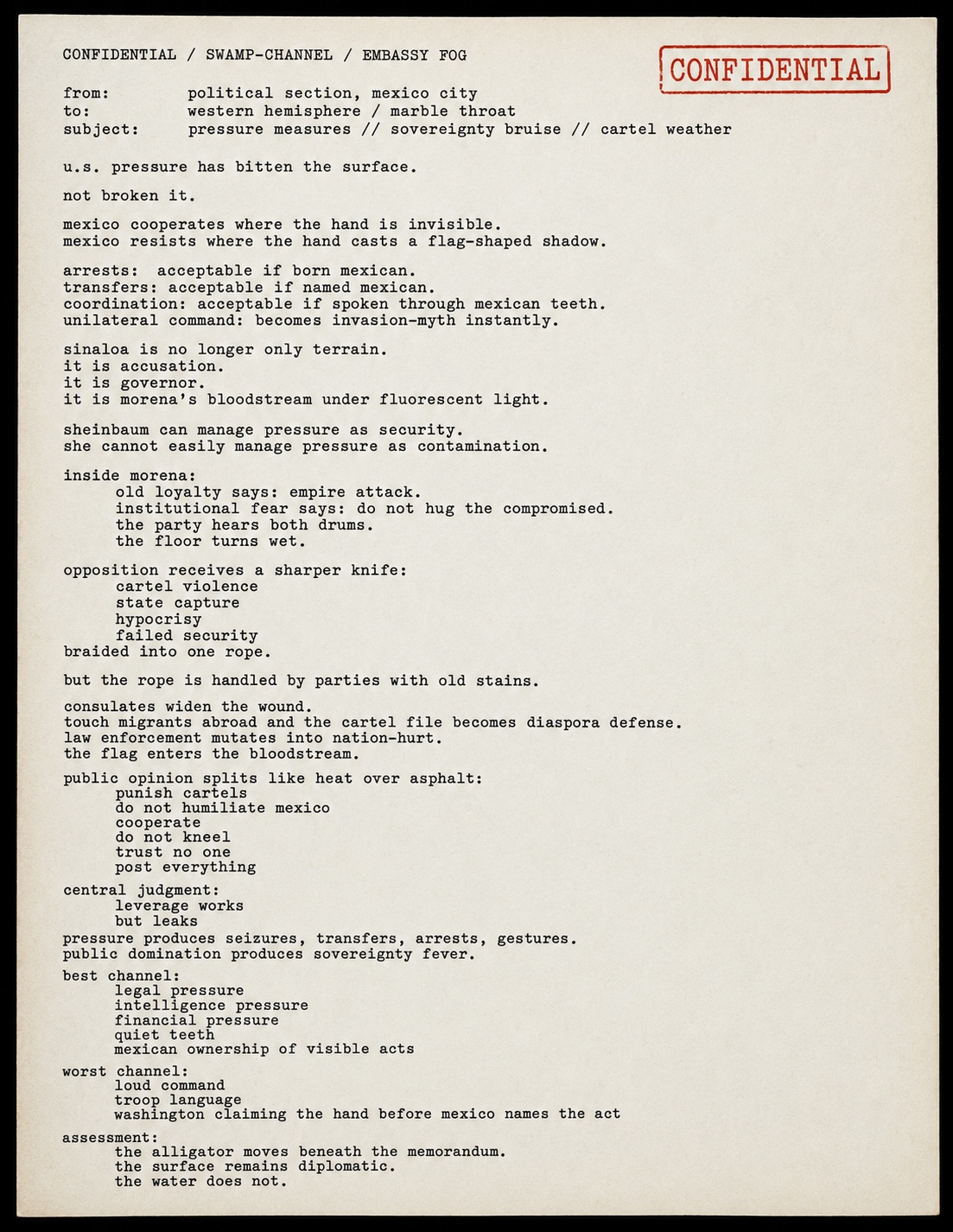
This reads as a stylized intelligence memo about how U.S. pressure on Mexico over cartel violence creates visible political effects without actually breaking Mexico’s sovereignty position or resolving the underlying cartel problem. “U.S. pressure has bitten the surface. not broken it” means Washington can force seizures, arrests, transfers, and public gestures, but only up to the point where Mexico can present those actions as its own sovereign decisions.
The core logic is that Mexico will cooperate when U.S. influence stays deniable. Arrests are politically acceptable when the people arrested are Mexican; transfers or extraditions are acceptable when Mexico can frame them through Mexican legal authority; coordination is acceptable when spoken through Mexican institutions. Direct U.S. command, troop language, or public claims of control immediately become politically toxic because they let Mexico’s government and public treat the pressure as an invasion narrative.
“Sinaloa is no longer only terrain. it is accusation. it is governor. it is morena’s bloodstream under fluorescent light” means the Sinaloa cartel is not just a security issue or geographic cartel base anymore; it has become a political contamination problem for Morena and Claudia Sheinbaum. Any U.S.-Mexico cartel action risks implying that Morena, state officials, or parts of the governing coalition are compromised. Sheinbaum can manage cartel pressure when it is framed as security policy, but not when it becomes a public test of whether her party is penetrated by organized crime.
Inside Morena, the memo imagines a split between old nationalist loyalists who see U.S. pressure as imperial aggression and institutional operators who understand that visibly defending compromised actors would be politically dangerous. “The party hears both drums. the floor turns wet” means the party is under simultaneous nationalist and corruption-pressure stress, creating instability and fear.
The opposition gains a stronger attack line because cartel violence, state capture, hypocrisy, and failed security can now be tied together. But the memo also undercuts the opposition by saying the rope is “handled by parties with old stains,” meaning PRI, PAN, or other rivals can weaponize the issue, but they lack clean hands because previous governments also had cartel-security scandals.
The consulates and migrants section says U.S. pressure spills into diaspora politics. When U.S. law enforcement touches migrants or Mexican nationals abroad, cartel enforcement becomes a national dignity issue. “The flag enters the bloodstream” means nationalism spreads fast once Mexicans feel their people are being targeted or humiliated by U.S. action.
The public reaction is described as fragmented and overheated: people want cartels punished but also do not want Mexico humiliated; they want cooperation but not submission; they distrust all sides and post everything. The practical conclusion is that covert or deniable leverage works, but leaks and public domination create “sovereignty fever,” meaning a backlash that forces Mexico to resist even useful cooperation.
The “best channel” is quiet legal, intelligence, and financial pressure, with Mexico publicly owning the visible acts. The “worst channel” is loud command, troop rhetoric, or Washington publicly claiming credit before Mexico names the action itself. The final assessment, “the alligator moves beneath the memorandum. the surface remains diplomatic. the water does not,” says the real coercion, cartel penetration, and power struggle remain submerged beneath polite diplomatic language. The memo’s plain meaning: U.S. leverage can move Mexico, but only if it stays invisible; public pressure turns a cartel-security campaign into a sovereignty crisis.
User
Okay, what I wanted to do is to research it and tell me is it true? Which bits are true? Which bits of false anything like that?
Assistant
The document itself is almost certainly not a real U.S. diplomatic or intelligence memo. Its format uses convincing bureaucratic cues, but the labels “SWAMP-CHANNEL,” “EMBASSY FOG,” “marble throat,” and “cartel weather” do not match normal State Department, intelligence, or legal classification language, and exact-phrase searches for the distinctive lines turn up no credible provenance. The prose is also poetic and analytical rather than operational: real cables do not usually say things like “the alligator moves beneath the memorandum.” So the artifact is best treated as a fictional or stylized analytic piece built around real political dynamics, not as leaked evidence.
The broad argument is partly true. The United States has been applying heavy pressure on Mexico over cartels, fentanyl, migration, and security cooperation. Trump’s 2025 executive order created a process to designate cartels and similar groups as foreign terrorist organizations or specially designated global terrorists, and reporting at the time said Mexico feared that such designations could become a pretext for unilateral U.S. action. Sheinbaum responded by emphasizing sovereignty, “collaboration” rather than intervention, and constitutional protections against foreign interference. (whitehouse.gov)
The memo’s line that Mexico cooperates when the U.S. hand is “invisible” is directionally true, but overstated. Mexico has cooperated visibly with the U.S., including major prisoner transfers and extraditions. In February 2025, Mexico sent 29 drug traffickers to the U.S., including Rafael Caro Quintero, amid tariff and security pressure; in August 2025, Mexico transferred 26 more cartel suspects, including figures linked to CJNG and Sinaloa; and in January 2026, Mexico sent 37 suspected cartel members to the U.S., bringing the reported total to 92 transfers in less than a year. Sheinbaum framed these moves as sovereign Mexican decisions, which supports the memo’s point that Mexico needs public ownership of the act even when U.S. pressure is a major driver. (ft.com)
The warning that “unilateral command becomes invasion-myth instantly” is broadly true. Sheinbaum has repeatedly rejected U.S. military action or “boots on the ground” in Mexico as a sovereignty issue. Reporting has described U.S. threats or offers of military action against cartels as politically explosive in Mexico, and Sheinbaum’s public line has been cooperation without subordination. (theguardian.com)
The Sinaloa/Morena contamination claim is also partly true, but it should be treated carefully. Recent reporting says U.S. prosecutors charged Sinaloa Governor Rubén Rocha Moya and other current or former Sinaloa officials with alleged ties to the Sinaloa cartel, and that this created a serious political problem for Sheinbaum and Morena. Rocha denies wrongdoing, and U.S. allegations are not the same thing as proven guilt. So the memo’s phrase “Morena’s bloodstream” is an interpretive, accusatory metaphor, not an established fact. The verified version is narrower: U.S. allegations against Morena-linked Sinaloa officials have created political pressure and reputational risk for Morena. (theguardian.com)
The claim about a Morena split appears plausible and is supported by reporting, though the memo dramatizes it. Reuters reported that Sheinbaum faced internal Morena conflict after U.S. cartel charges, with one faction denouncing U.S. interference and another more open to confronting alleged corruption. That matches the memo’s “old loyalty” versus “institutional fear” framing, though the memo compresses a complex party dispute into theatrical language. (reuters.com)
The opposition angle is also plausible but not something the memo proves. It is true that cartel violence, state capture, and security failure are obvious opposition attack lines against Morena. It is also fair political analysis that older opposition parties have their own histories of cartel and corruption scandals, weakening their ability to use the issue cleanly. But that part is analysis, not a discrete factual claim I can verify as a single event.
The public-opinion section is broadly credible: Mexicans can support action against cartels while opposing humiliation or U.S. intervention. That tension is consistent with Sheinbaum’s repeated insistence on cooperation without subordination and with the political sensitivity around U.S. military involvement. But the exact list in the memo, “punish cartels / do not humiliate Mexico / cooperate / do not kneel,” is rhetorical synthesis, not polling data shown in the document.
The false or unsupported parts are mainly the document’s implied authenticity and some overcompressed causal claims. There is no evidence from the image that this is a real confidential cable. There is no proof in the document that Morena as a whole is cartel-contaminated, only that allegations and investigations involving Sinaloa officials create political risk. There is no proof that U.S. pressure alone “produces” Mexican arrests or transfers, because Mexico also has its own security incentives. And the “best channel/worst channel” section is strategic analysis, not a verified policy directive.
My bottom line: the memo is not reliable as a primary source, but its underlying analysis is substantially grounded in real events. The true core is that U.S. pressure on Mexico over cartels has intensified; Mexico has made major cartel transfers while insisting they are sovereign decisions; Sheinbaum strongly rejects unilateral U.S. intervention; Sinaloa cartel allegations have become politically dangerous for Morena; and public cooperation is easier when Mexico can claim ownership. The untrue or unproven part is the presentation as a confidential inside memo and the insinuation that all the political contamination it describes is already established fact.
User
On a scale of one to 10, how would you rate it as a highly compressed artefact of a real situation?
Assistant
I’d rate it about 8 out of 10 as a compressed artifact of a real situation, but only about 2 out of 10 as a plausible real confidential memo.
As political compression, it is strong. It captures the central dynamic: U.S. pressure can move Mexican security policy, but overt U.S. dominance triggers sovereignty backlash; Sheinbaum must cooperate enough to avoid U.S. escalation while preserving Mexican ownership; cartel allegations around Sinaloa create contamination risk for Morena; and the opposition can weaponize the issue despite having its own credibility problems. Those are real pressures, and the artifact condenses them efficiently.
Its main weakness is that it over-poeticizes and over-totalizes. Phrases like “Morena’s bloodstream” and “the alligator moves beneath the memorandum” are evocative but not evidentiary. They turn partial, contested, and institution-specific issues into a sweeping diagnosis of systemic contamination. That makes it analytically useful as a mood-map, but dangerous if read as factual reporting.
So my rating is: 8/10 as a stylized geopolitical-politico intelligence poem, 6.5/10 as an analytic brief if stripped of melodrama, and 2/10 as an authentic leaked document. Its strongest truth is structural; its weakest truth is evidentiary.
User
Okay, what I wanted to do is to carefully transcribe this entire conversation into a file and make it clear what when the assistant speaking and when the user is speaking I’d like to have a markdown file and then give me a link to it so transcribe it very carefully I don’t want to lose anything and then give me a link so I can download it.