Recognition
Fear is allowed to signify. History is admitted into the present. Institutions become answerable to the conditions that produced the claim, and protection appears as an act of repair rather than concession.
Wall work with text
A meditation on how public fear is read, granted weight, or denied it. The work traces a quiet violence in the movement from protection to permission: the moment when a claim of danger is not answered, but reclassified.
View the work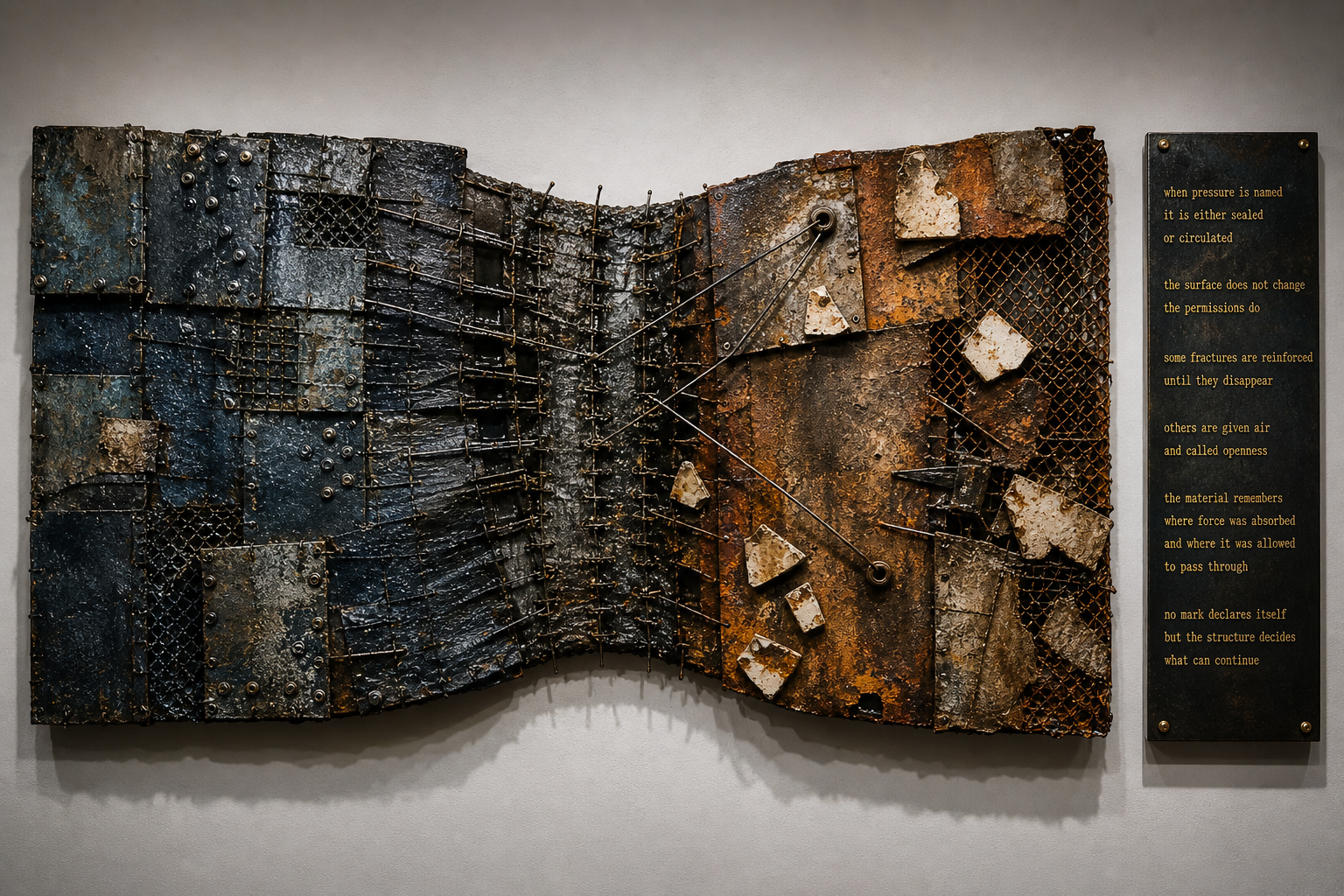
Premise
A minority community says that it feels unsafe. From that point, the same sentence can be made to travel in two different directions. It can be heard as a sign of possible harm, calling institutions toward recognition, restraint, memory, and repair. Or it can be treated as an inconvenience to public freedom, folded into the language of openness until hostility appears clean, civic, and permissible.
The question is not simply whether harm exists. It is how harm is named, who is believed when they describe it, and why some forms of intimidation are absorbed by the public conscience while others are allowed to circulate as culture.
Fear is allowed to signify. History is admitted into the present. Institutions become answerable to the conditions that produced the claim, and protection appears as an act of repair rather than concession.
Hostility is given civic clothing. It is renamed as debate, expression, criticism, solidarity, or art. The injury remains, but the grammar around it changes until the target is asked to accept exposure as openness.
The work asks what happens when public principles are not applied evenly. Safety, freedom, hate, and criticism become unstable terms, shifting their meaning according to the group placed beneath them.
Material logic
On the left, plates overlap and hold. Bolts gather densely across blue-black metal. Cracks are filled, seams are stitched, and force is drawn into systems of reinforcement.
On the right, rust advances without interruption. Mesh opens, fragments loosen, and the surface begins to define itself by what it allows to pass through.
Between them, wires cross a compressed field without joining. The middle is not a bridge but a wound: a zone where incompatible forms of public reason meet and fail to reconcile.
The vertical plaque stands beside the object like a remainder. Its gold lettering does not explain the work so much as echo its law: pressure is either stopped or circulated.
Inscription
when pressure is named
it is either sealed
or circulated
the surface does not change
the permissions do
some fractures are reinforced
until they disappear
others are given air
and called openness
the material remembers
where force was absorbed
and where it was allowed
to pass through
no mark declares itself
but the structure decides
what can continue
Works

Reading
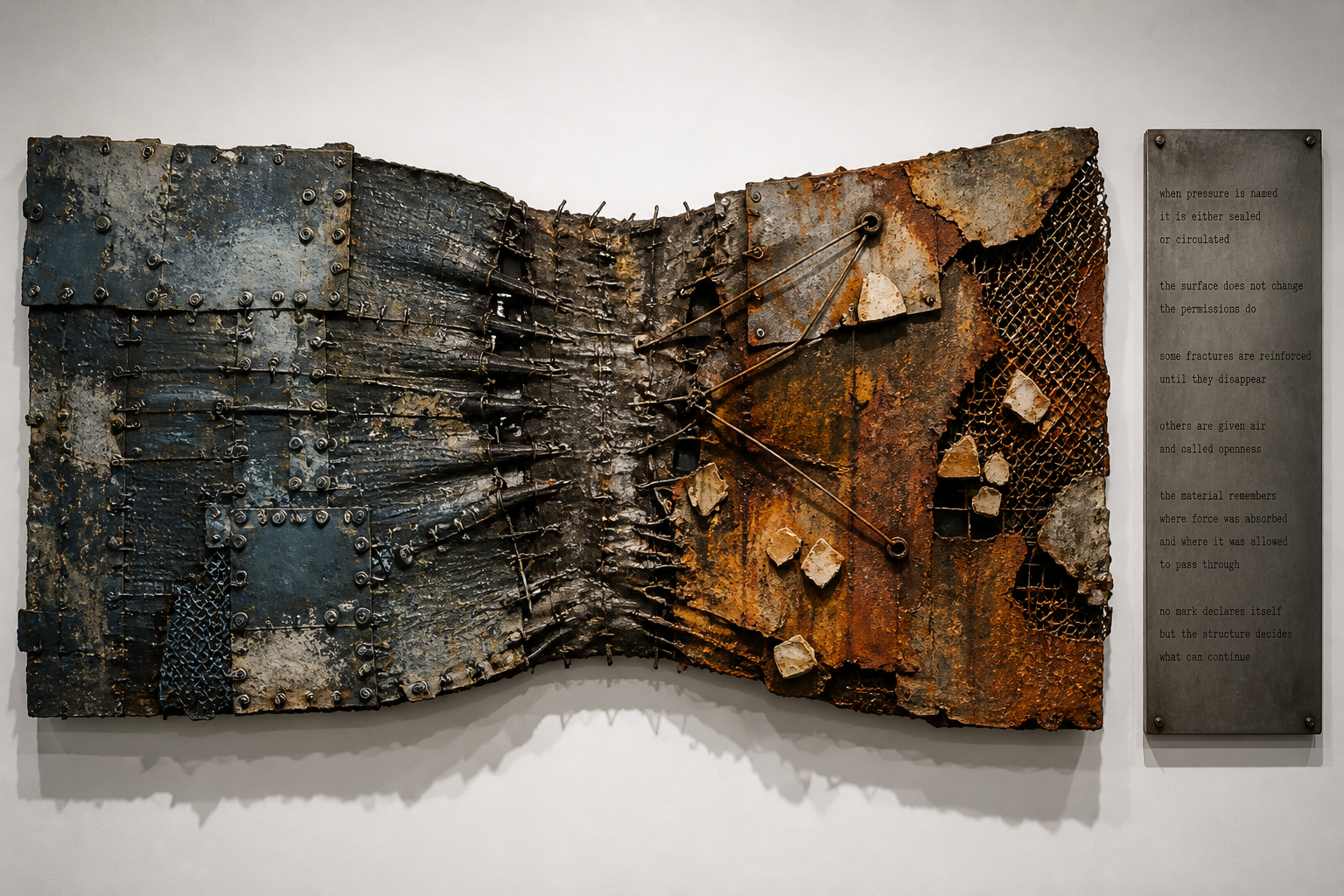
The work is about the unequal life of public principles. It asks why one claim of unsafety can summon care while another is made to disappear inside the vocabulary of tolerance. Its materials do not resolve that contradiction; they hold it open.
One side bears the marks of intervention. The other bears the marks of permission. Between them, the viewer encounters a system that does not merely respond to pressure, but decides what pressure is allowed to become.